
Transit Advertising in Toronto
Transit Advertising in Toronto
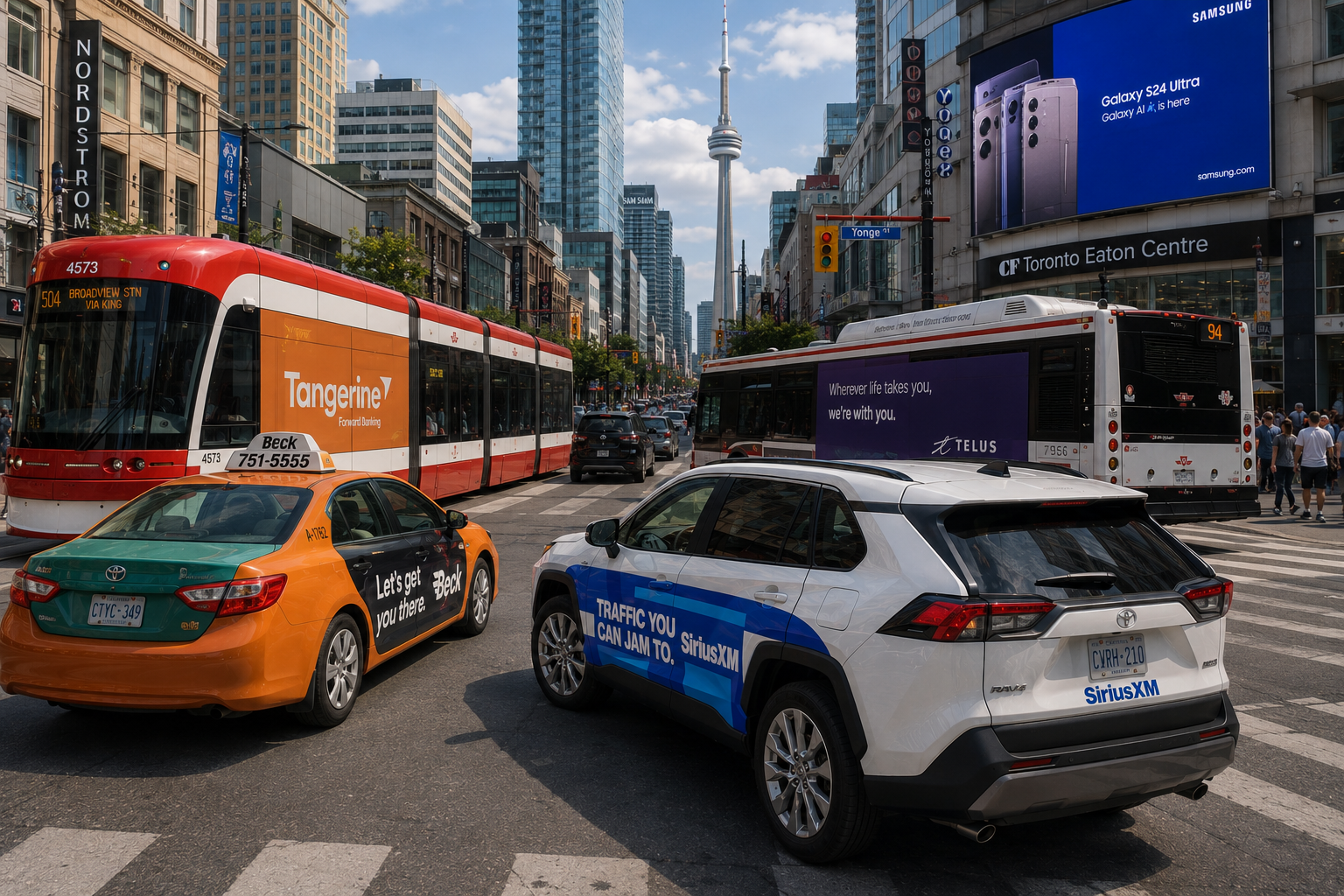
If you're a brand trying to get noticed in this city, you've got options. More than most people realize. Toronto's transit advertising landscape isn't just buses and subway posters anymore... it's buses, cabs, LED trucks, and wrapped gig vehicles all fighting for the same eyeballs. Here's how they actually stack up.
TTC (buses, streetcars, subway)
This is the OG. Pattison Outdoor runs pretty much all of it... buses, streetcars, subway stations, the works. And there's a reason it's stood the test of time: TTC ridership is massive, and a streetcar rolling down King Street with a full wrap is still one of the most recognizable ad formats in the city.
The tradeoff is flexibility. You're buying fixed routes and fixed placements. Your ad shows up where the TTC goes, not where your audience actually is. Great for broad reach and legitimacy... not built for precision targeting around a launch, an event, or a specific neighborhood.
Taxi wraps
Taxi advertising has been around for a while too, and it's closer to what we do... a wrapped vehicle moving through the city. The difference is fleet control and flexibility. Taxi companies run fixed routes tied to dispatch and airport runs, and the creative/placement options are usually more limited. It works, but it's a narrower version of the mobility media idea.
LED / digital mobile billboard trucks
These are the attention grabbers. A truck with a massive digital screen parked outside a stadium or circling a festival is impossible to ignore, and it's great for a short, loud burst tied to a specific moment. But that's exactly what it is... a burst. You're renting a truck for a day or a weekend, not building sustained presence across the city. Cost per day is high, and once the truck's gone, so is the impression.
Vehicle wraps (gig economy fleets)
This is our lane. Instead of one truck or a fixed route, you get a fleet of Uber, DoorDash, Skip, and other gig vehicles wrapped and driving through the city all day, every day, as part of their actual jobs. That means:
- Real coverage. Not one route... dozens of drivers covering downtown, the neighborhoods, the suburbs, all at once.
- Constant movement. These cars aren't parked. They're in entertainment districts at night and residential streets in the morning.
- Flexibility. We can build a SWARM around a concert or a launch, or run a steady city-wide campaign for months. Try doing that with a subway ad.
- Attribution. MAID passback means we can retarget people who were physically near the campaign. TTC and taxi wraps can't touch that.
Where wrapped fits
We're not trying to replace the TTC or knock LED trucks. Honestly, a smart media plan probably uses more than one of these. TTC gets you scale and credibility. LED trucks get you a big moment. What we bring is the thing neither of those can: a mobile network that moves through the entire city, all day, with the flexibility to go where your audience actually is and the data to prove it worked.
It's not about who's the "best" format. It's about picking the right tool for what you're actually trying to do. For city-wide, high-frequency, measurable mobility media... that's us.
Related Articles

The TL;DR
Three years ago, my business partner Davis and I quit our jobs, signed a lease on a 100-square-foot co-working space, and bet on an idea: that the gig economy had quietly built one of the most powerful advertising networks in North America — and nobody was using it properly.
The idea was simple. Rideshare and delivery drivers are already on the road, already moving through every neighbourhood, every entertainment district, every downtown core in every major city. Put a brand on that vehicle, and suddenly you have a mobile billboard that never stands still. No fixed location. No single intersection. A message that follows the city wherever it goes.
We started small. A handful of drivers. A few local campaigns. A lot of figuring things out on the fly.
Three years later, Wrapped Media runs campaigns across Canada and the United States for some of the biggest brands in the world — Wendy's, Walmart, Mercedes, Disney, Hot Wheels. We've activated at festivals, sporting events, and cultural moments in virtually every major Canadian market. We've added pedicabs, SWARM activations, in-vehicle advertising, and digital attribution to what started as a pretty straightforward idea about car wraps.
The business looks nothing like that first office. But the core of it is exactly the same: help great brands show up in the real world in ways that actually get noticed.
We're heading into what feels like the most exciting chapter yet. FIFA World Cup is coming to Toronto this summer. Alberta's iGaming market is about to open. New formats, new markets, new campaigns are in the works.
We built this thing from scratch. We're just getting started.
— Ian Feil, Co-Founder, Wrapped Media
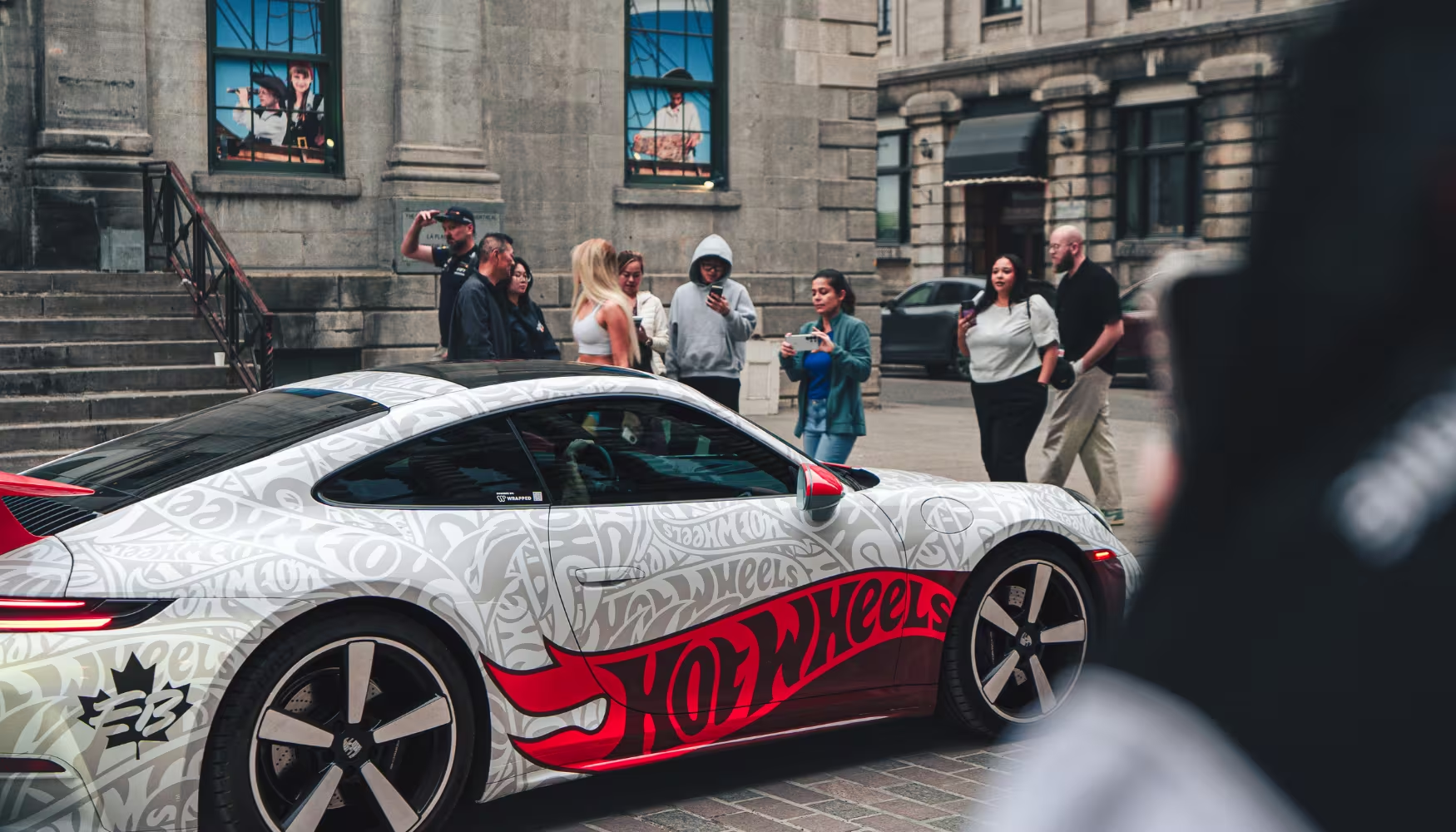
I'll be honest — I've been in this industry long enough to know when a campaign is going to be good. But nothing fully prepared me for what happened when we put two Hot Wheels-wrapped Porsche 911s on the streets of Montreal during Grand Prix weekend.
Let me back up.
The Brief
Wrapped Media partnered with Mattel to bring one of the most iconic toy brands in the world to life on the streets of one of the most iconic race weekends in the world. The brief was simple in concept and wildly fun in execution: wrap two Porsche 911s in full Hot Wheels branding and swarm them through downtown Montreal while the city was packed with Formula 1 fans from around the globe.
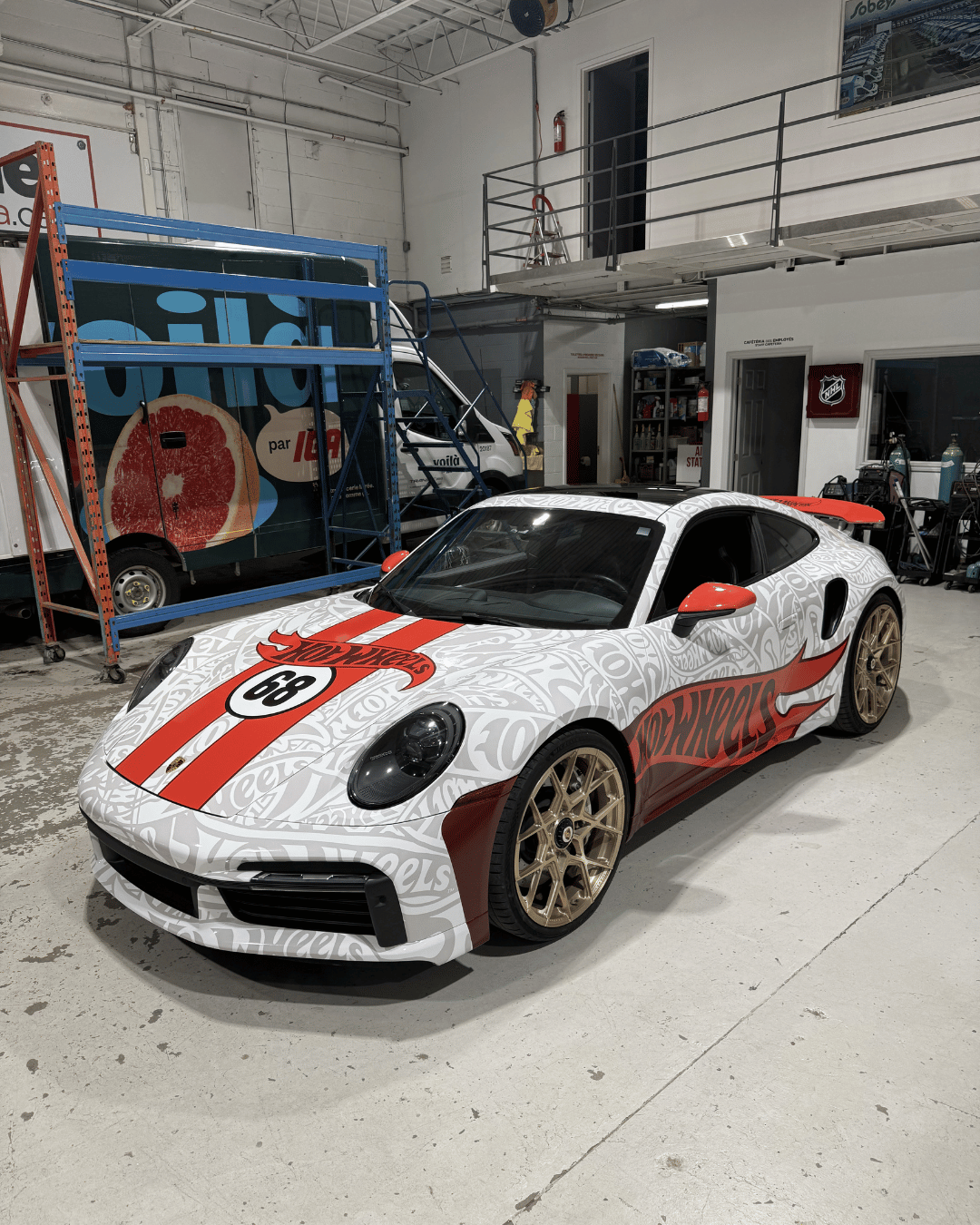
The wraps themselves are something else. White base, bold red Hot Wheels logo running the length of the door, the classic flame graphic, graffiti-style lettering covering every panel. On a Porsche 911 with bronze wheels, it looks like something that just rolled off the toy aisle and onto the street at full scale.
Through the Streets of Old Montreal
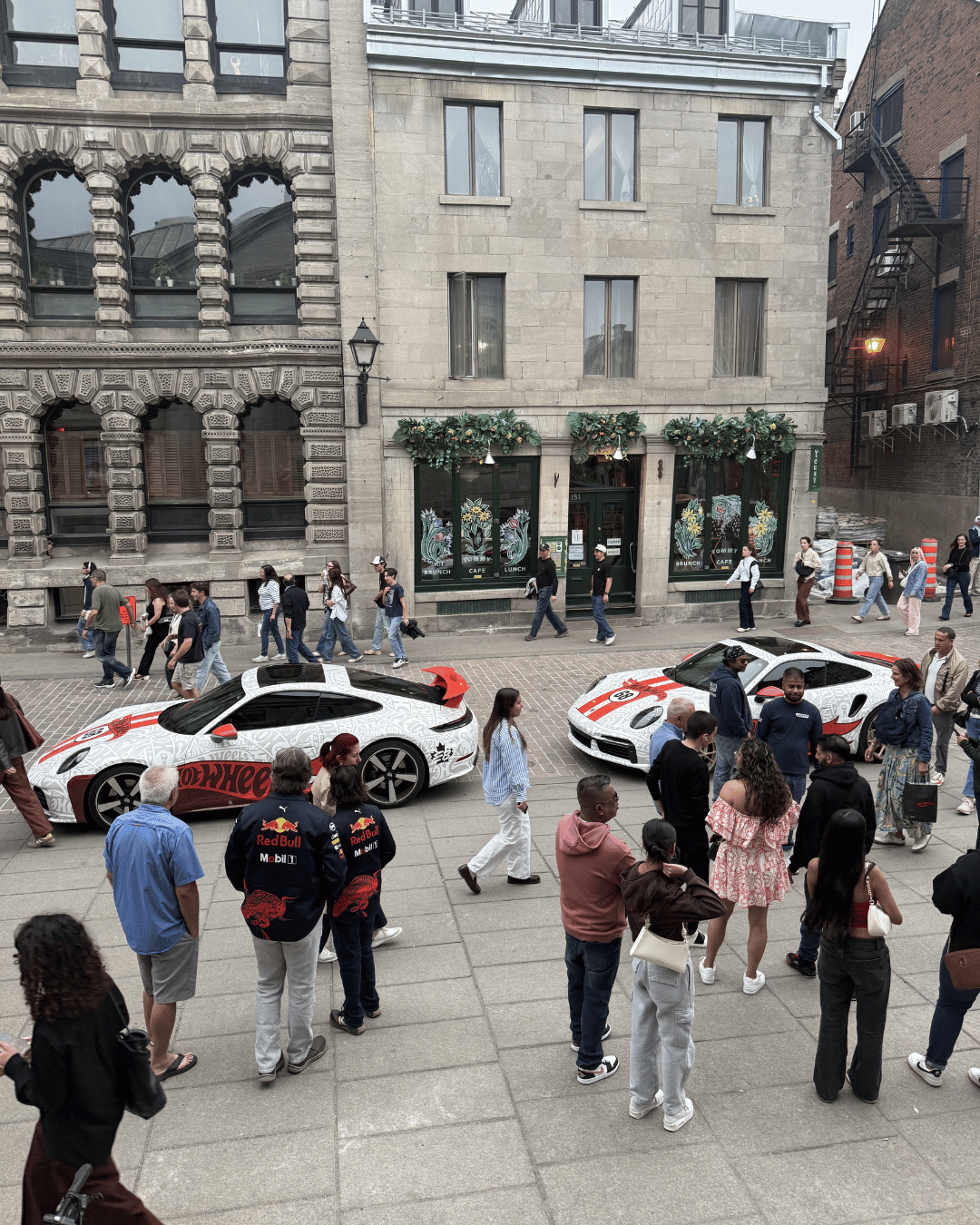
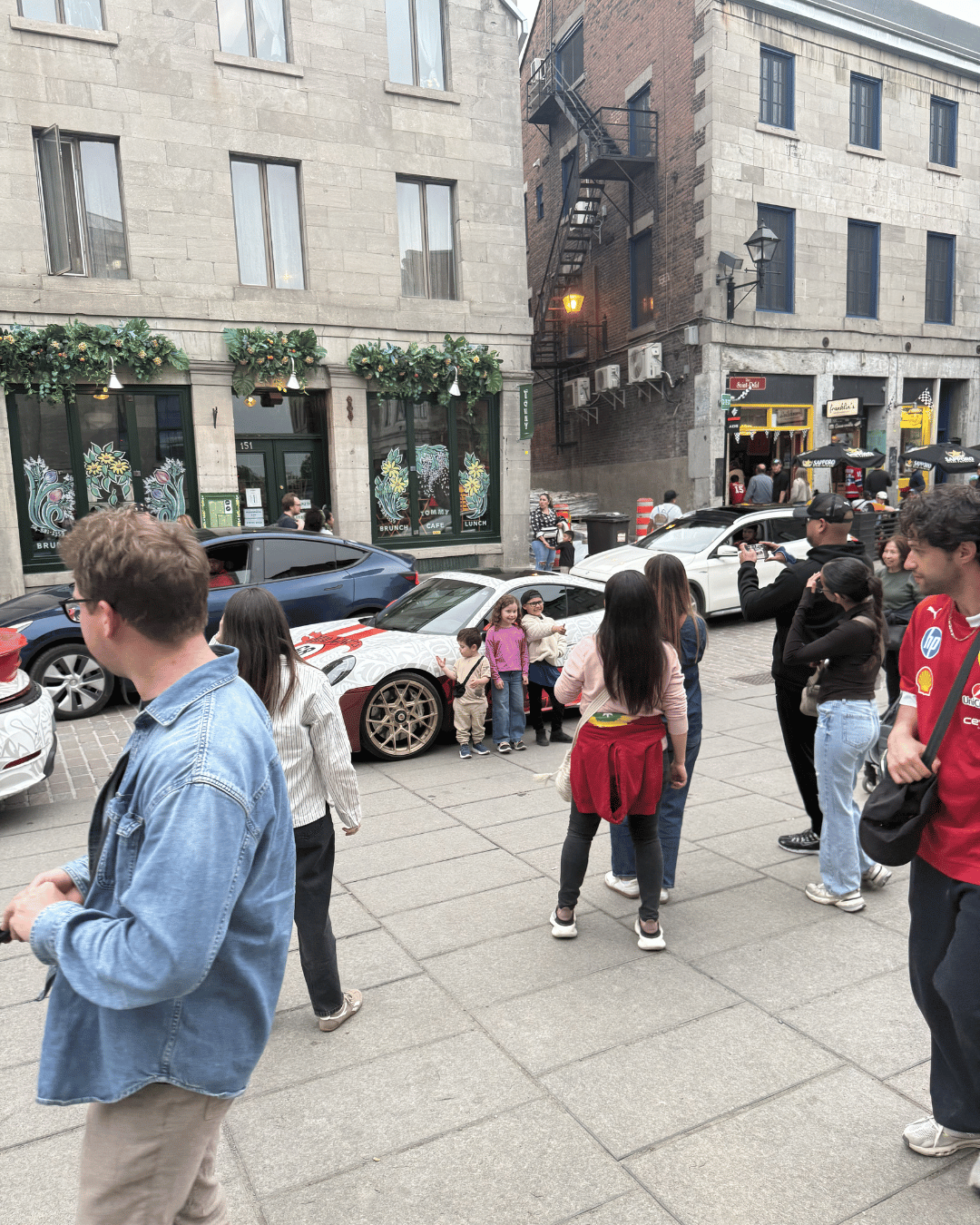
We drove through Old Montreal and the Old Port, past the hotel district where the Ritz Carlton and Four Seasons were overflowing with race weekend guests, and straight through the heart of downtown. The cobblestone streets of Vieux-Montréal were practically made for this. Stone buildings, packed terrasses, Formula 1 energy everywhere — and two Hot Wheels Porsches rolling through the middle of it all.
A Reaction I Wasn't Ready For
The reaction was something I genuinely wasn't ready for.
There were intersections where I counted thirty to forty cameras pointed directly at us. People were stopping mid-sentence. Kids were pointing and yelling. Strangers were running into the street to get a better shot. At one point we parked in the square in the Old Port and within minutes had a full crowd circling both cars, phones out, kids pressing their faces up against the windows.
I'm not used to having that many cameras pointed at me. It took a second to get used to. Obviously they weren't pointed at me — they were pointed at the cars. But when you're behind the wheel of something that stops a city block, you feel it.
The Best Part Wasn't the Attention
The best part wasn't the attention though. It was the kids.
Every time a kid saw these cars — really saw them, recognized the logo, made the connection — their face just lit up. That instant moment of recognition where a toy they grew up with is suddenly real and right in front of them, bigger than a building and louder than anything they expected. That's the kind of brand moment you can't manufacture with a digital ad. It lives in that kid's memory for years.
Hanging With the Mattel Team
We were also lucky enough to spend the weekend with Leo and Lisa from the Mattel team, who were in Montreal for the event. Getting to drive around with the people behind the brand and watch the campaign land in real time — that's a rare thing. It made an already great campaign feel like a genuine collaboration.
This Is What SWARM Is Built For
This is what SWARM is built for. A specific city, a specific moment, a brand that means something to people. You don't need a billboard. You just need to show up in the right place at the right time with something that makes people stop and feel something.
Montreal during F1 weekend. Hot Wheels on Porsches. Cameras everywhere.
We'll be back.
-Ian Feil, Co-founder, Wrapped