
Transit Advertising in Vancouver
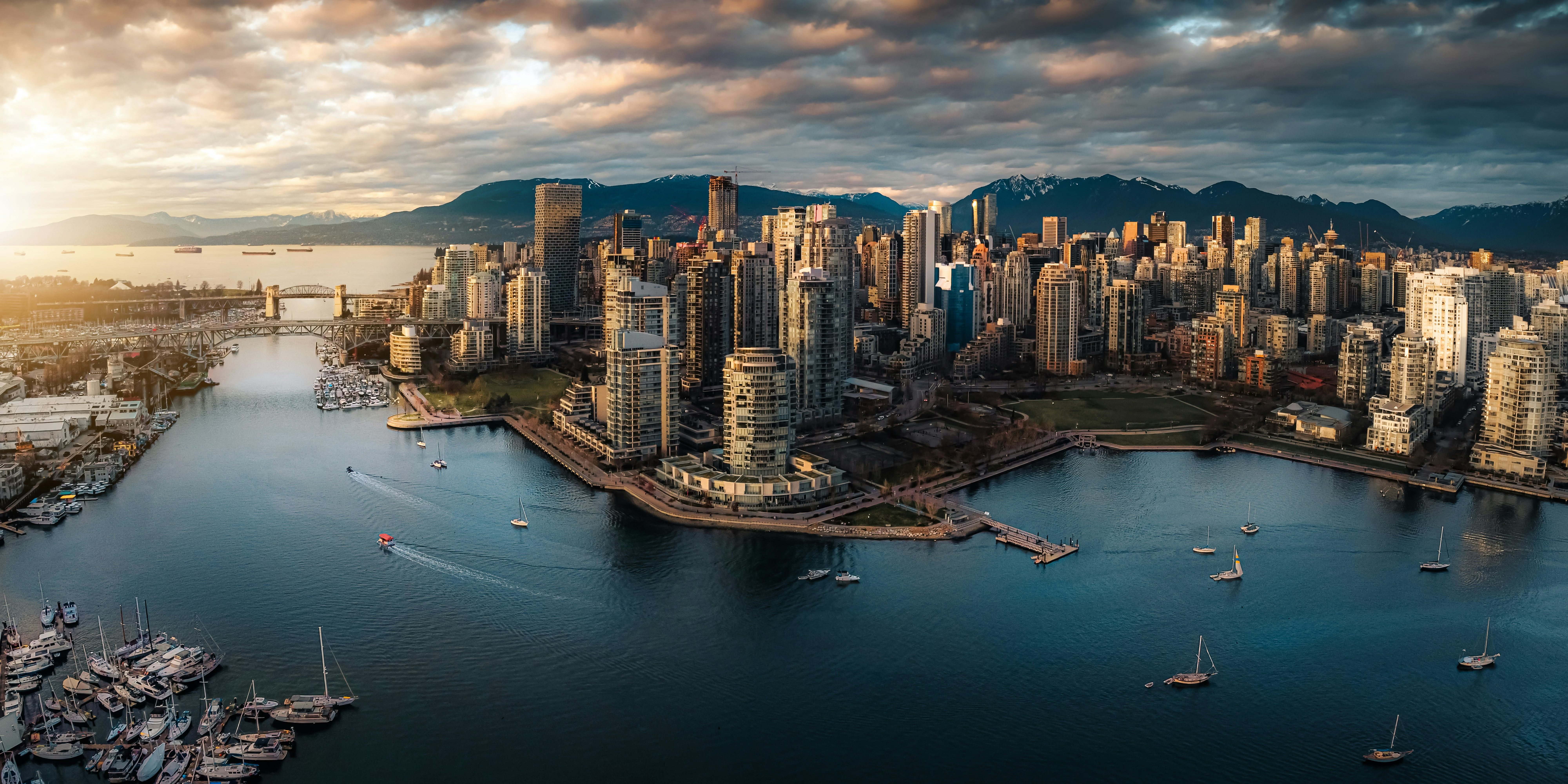
Transit Advertising in Vancouver
If you're a brand trying to get noticed in this city, you've got options. More than most people realize. Vancouver's transit advertising landscape isn't just buses and SkyTrain posters — it's buses, LED trucks, pedicabs, and wrapped gig vehicles all fighting for the same eyeballs. Here's how they actually stack up.
TransLink (buses, SkyTrain, SeaBus)
This is the OG. Pattison Outdoor took over as TransLink's main ad provider in August 2025 — buses, SkyTrain, SeaBus, and the West Coast Express, the works. Before that it was Lamar for years, so this is still a fairly fresh setup, but the inventory itself is as strong as ever. Vancouver's the only major North American city without a freeway system, which means arterials and transit corridors carry a ton of the traffic that would otherwise be on a highway — and a SkyTrain wrap or a bus rolling down Broadway gets serious, sustained exposure because of it.
The tradeoff is the same one every city has with fixed transit: you're buying set routes and set stations. Your ad shows up where TransLink goes, not necessarily where your audience actually is. Great for broad reach and legitimacy — not built for precision targeting around a launch, an event, or a specific neighborhood.
LED / digital mobile billboard trucks
These are the attention grabbers, but Vancouver's bylaws are stricter here than a lot of cities. The screens generally can't be lit up while the truck is actually driving — they're built for parking near a venue or event and running the display while stationary, not for cruising the city with the screen on. So a truck parked outside Rogers Arena or camped near a festival in Yaletown can still be impossible to ignore. But that's the model — a stationary burst tied to a specific moment, not sustained citywide movement. Cost per day is high, and once the truck packs up, so does the impression.
Pedicabs
This one's more niche, but it's a real category here — pedicabs threading through Gastown, the West End, and downtown during events, festivals, and busy weekend nights. They're slow-moving, low-key, and get right up close to pedestrians in a way cars can't, which makes them a nice fit for experiential or event-tied campaigns rather than mass reach. Not a citywide play on its own, but a good complement to a bigger campaign when you want a physical presence right in the middle of foot traffic.
Vehicle wraps (gig economy fleets)
This is our lane. Instead of one truck or a fixed route, you get a fleet of Uber, DoorDash, Skip, and other gig vehicles wrapped and driving through the city all day, every day, as part of their actual jobs. That means:
- Real coverage. Not one route — dozens of drivers covering downtown, Kitsilano, Mount Pleasant, the North Shore, all at once.
- Constant movement. These cars aren't parked. They're in Gastown and Yaletown at night and residential streets in the morning.
- Flexibility. We can build a SWARM around a concert or a launch, or run a steady city-wide campaign for months. Try doing that with a SkyTrain ad.
- Attribution. MAID passback means we can retarget people who were physically near the campaign. TransLink, LED trucks, and pedicabs can't touch that.
Where Wrapped fits
We're not trying to replace TransLink or knock LED trucks. Honestly, a smart media plan probably uses more than one of these. TransLink gets you scale and credibility. LED trucks get you a big moment. What we bring is the thing neither of those can: a mobile network that moves through the entire city, all day, with the flexibility to go where your audience actually is and the data to prove it worked.
It's not about who's the "best" format. It's about picking the right tool for what you're actually trying to do. For city-wide, high-frequency, measurable mobility media in Vancouver — that's us.
Related Articles
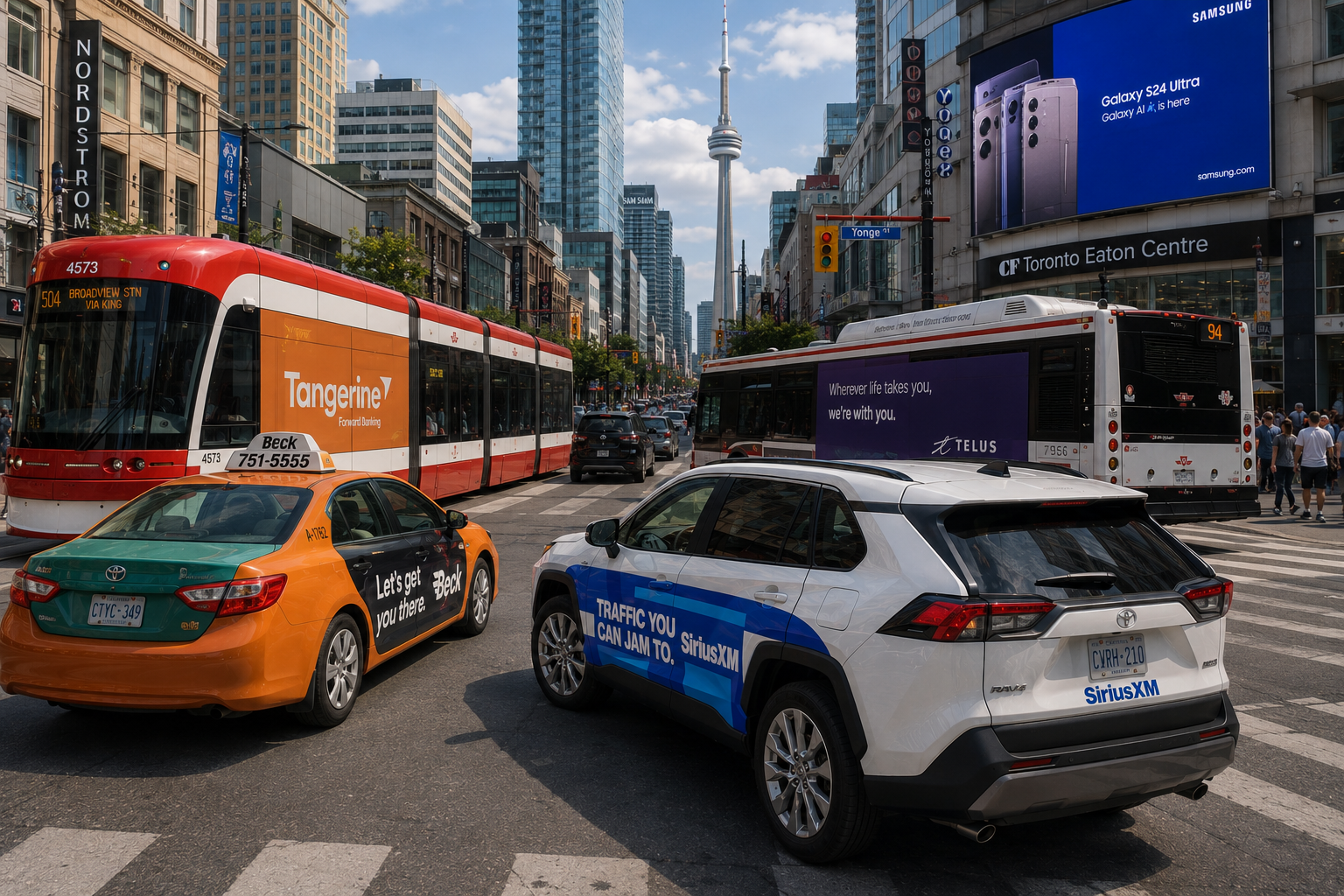
Transit Advertising in Toronto
If you're a brand trying to get noticed in this city, you've got options. More than most people realize. Toronto's transit advertising landscape isn't just buses and subway posters anymore... it's buses, cabs, LED trucks, and wrapped gig vehicles all fighting for the same eyeballs. Here's how they actually stack up.
TTC (buses, streetcars, subway)
This is the OG. Pattison Outdoor runs pretty much all of it... buses, streetcars, subway stations, the works. And there's a reason it's stood the test of time: TTC ridership is massive, and a streetcar rolling down King Street with a full wrap is still one of the most recognizable ad formats in the city.
The tradeoff is flexibility. You're buying fixed routes and fixed placements. Your ad shows up where the TTC goes, not where your audience actually is. Great for broad reach and legitimacy... not built for precision targeting around a launch, an event, or a specific neighborhood.
Taxi wraps
Taxi advertising has been around for a while too, and it's closer to what we do... a wrapped vehicle moving through the city. The difference is fleet control and flexibility. Taxi companies run fixed routes tied to dispatch and airport runs, and the creative/placement options are usually more limited. It works, but it's a narrower version of the mobility media idea.
LED / digital mobile billboard trucks
These are the attention grabbers. A truck with a massive digital screen parked outside a stadium or circling a festival is impossible to ignore, and it's great for a short, loud burst tied to a specific moment. But that's exactly what it is... a burst. You're renting a truck for a day or a weekend, not building sustained presence across the city. Cost per day is high, and once the truck's gone, so is the impression.
Vehicle wraps (gig economy fleets)
This is our lane. Instead of one truck or a fixed route, you get a fleet of Uber, DoorDash, Skip, and other gig vehicles wrapped and driving through the city all day, every day, as part of their actual jobs. That means:
- Real coverage. Not one route... dozens of drivers covering downtown, the neighborhoods, the suburbs, all at once.
- Constant movement. These cars aren't parked. They're in entertainment districts at night and residential streets in the morning.
- Flexibility. We can build a SWARM around a concert or a launch, or run a steady city-wide campaign for months. Try doing that with a subway ad.
- Attribution. MAID passback means we can retarget people who were physically near the campaign. TTC and taxi wraps can't touch that.
Where Wrapped fits
We're not trying to replace the TTC or knock LED trucks. Honestly, a smart media plan probably uses more than one of these. TTC gets you scale and credibility. LED trucks get you a big moment. What we bring is the thing neither of those can: a mobile network that moves through the entire city, all day, with the flexibility to go where your audience actually is and the data to prove it worked.
It's not about who's the "best" format. It's about picking the right tool for what you're actually trying to do. For city-wide, high-frequency, measurable mobility media... that's us.